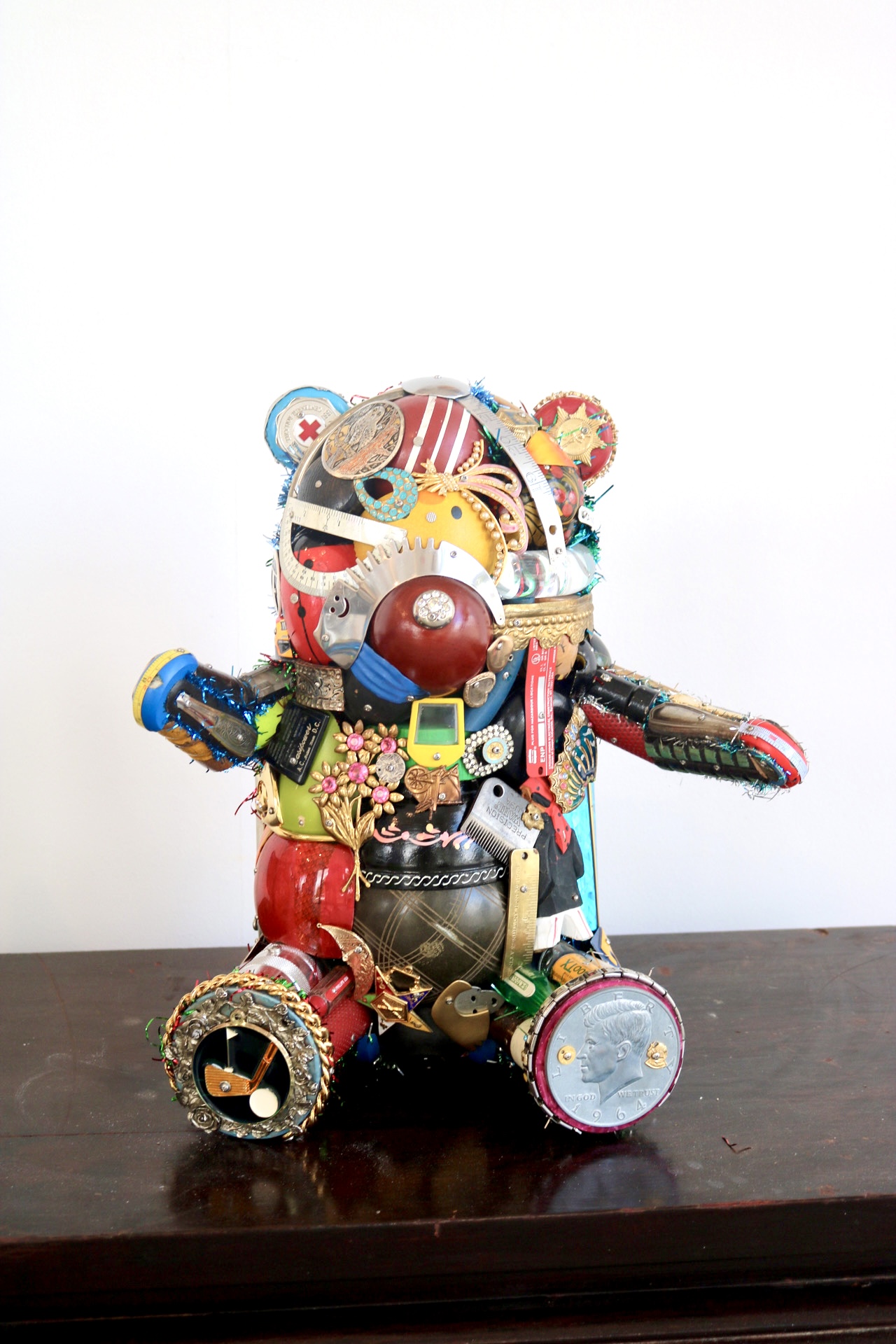
How a Found-Object Sculpture Is Made
A Leo Sewell found-object sculpture is built the way a mosaic is, but in three dimensions: thousands of small manufactured objects — metal, wood, and plastic — are sorted, selected for how they read, and fastened one at a time onto an armature until a recognizable form emerges. Nothing is cast and, characteristically, nothing is painted; the color you see is the original color of the objects themselves. It is slow, additive, and entirely handmade.
TL;DR
- The material is genuine refuse and cast-offs, gathered from trash, yard sales, and flea markets.
- Objects are chosen for color, shape, texture, durability, and patina — not just what they are.
- They're fastened with nails, bolts, and screws onto a form, worked from the inside out.
- It's a practice fifty years and more than 4,000 works deep, begun in a childhood spent near a naval dump.
- See the results in the recent work, or commission a piece of your own.
Where does the story start?
Before the method, there's the habit. Leo Sewell grew up in Annapolis near a naval-community dump, where he began playing with found objects before he was ten. With access to his father's workshop, he began creating assemblages using fasteners and welding — the same essential moves he still makes today. That's worth sitting with: the technique wasn't adopted from a school or a trend. It grew out of a childhood spent seeing potential in what other people had discarded.
Where do the objects come from?
Everything begins with gathering. The materials are collected from trash, yard sales, and flea markets — genuine cast-offs rather than art-supply stock. Over decades this becomes less like shopping and more like foraging: a trained eye for the one toy, gauge, key, or fragment of chrome that will do a job no other object can.
The studio runs on inventory. Before a single piece is assembled, there are bins and shelves of sorted material — by size, by color, by kind — so that when a form calls for a particular curve or a particular red, it's within reach.
How does Leo decide which object goes where?
This is the part that looks like magic and is actually judgment. Objects are selected for their color, shape, texture, durability, and patina — five criteria that turn a heap of junk into a palette. A bottle cap isn't chosen because it's a bottle cap; it's chosen because its curvature, its worn red enamel, and its size make it the right muscle on a haunch or the right glint in an eye.
That's why the work rewards close looking. From across a room you see a bear or a duck; up close, the surface dissolves into hundreds of tiny decisions — a typewriter key here, a toy soldier there — each placed for how it reads, not merely for what it is. Because color comes from the objects, the finish has a depth that paint can't imitate: it's the accumulated life of the materials.
How is the sculpture actually assembled?
The build is mechanical in the honest sense of the word. Using nails, bolts, and screws, Leo assembles the sculptures into a wide variety of subjects and sizes — from tabletop animals to life-size figures and monumental public installations. There's no glue-and-hope here; the pieces are fastened, structurally, to last.
Work generally proceeds from an internal form outward, the objects layered onto and around a supporting structure until the silhouette resolves and the surface fills in. Balance, weight, and durability are engineered as the piece grows — a sculpture that will live in a museum or a lobby has to survive handling, shipping, and years of display.
What can be built — from a house cat to a forty-foot torch?
The remarkable thing is how little the core method changes across wildly different scales. The same logic of gather, select, and fasten produces both the intimate and the monumental. The Benton Museum describes the range plainly: works including a house cat and other animals, a life-size lady and other figures — and, at the far end, a forty-foot Statue of Liberty hand and torch.
That span is possible because the technique is fundamentally structural. A tabletop animal and a monumental installation are built on the same principle — objects fastened to a sound internal form — so what changes with scale is engineering, not approach. Larger works demand more robust armatures, more attention to weight and balance, and materials chosen with durability front of mind, but the eye guiding object placement is the same eye at any size.
For a buyer or a commissioner, this is the practical takeaway: subject and scale are open. A pet-sized sculpture for a shelf and a room-defining centerpiece are both squarely within the practice, and both draw on the same decades of accumulated technique.
Why does it read as art and not as a pile of stuff?
Because of restraint and intent. The objects are recognizable — that's the pleasure — but they're marshaled toward a subject. Leo's work follows naturalistic themes, and the discipline is in making a thousand unrelated things agree on a single animal or figure. The tension between what the objects were and what they've become is the whole point: a discarded thing, given one more life, in the service of something that looks alive.
Restraint also shows up in editing. Not every interesting object earns a place; part of the craft is leaving things out so the subject stays legible. A surface that's merely busy reads as clutter, while a surface that's composed reads as a creature. That editorial judgment — knowing when a region has enough, when a color is fighting the form, when to stop — is the quiet skill underneath the obvious one, and it's the hardest part to teach. It's also why two artists working from the same bin of objects would never arrive at the same sculpture.
What does fifty years of one practice buy?
Fluency. Over the subsequent fifty years he has produced more than 4,000 sculptures — a body of work that turns intuition into reliability. A commissioned piece today isn't an experiment; it's the latest instance of a method refined across thousands of works, which is exactly why scale, subject, and durability are rarely obstacles.
If you want to see the process in its finished form, spend time with the recent work — look closely, and the objects reveal themselves. And if you'd like a piece built to your own subject, the studio takes commissions.