How to Commission a Found-Object Sculpture
To commission a found-object sculpture from Leo Sewell, you start with a conversation about your subject, size, and any objects you want built into the piece; Leo then returns a concept and estimate, builds the work by hand, and delivers it. It is a collaborative, made-to-order process — closer to commissioning a portrait than buying off a shelf. The best first step is the commissions page, where you can describe what you have in mind.
TL;DR
- A commission is a custom sculpture built to your subject and scale, often incorporating objects you supply.
- The path is: consultation → concept and estimate → hand assembly → delivery (and installation for large works).
- Leo Sewell has built more than 4,000 works over fifty years, from tabletop animals to a forty-foot Statue of Liberty hand — so scale is rarely the obstacle.
- Cost and timeline depend on size and complexity; start on the commissions page for a specific quote.
What is a found-object commission?
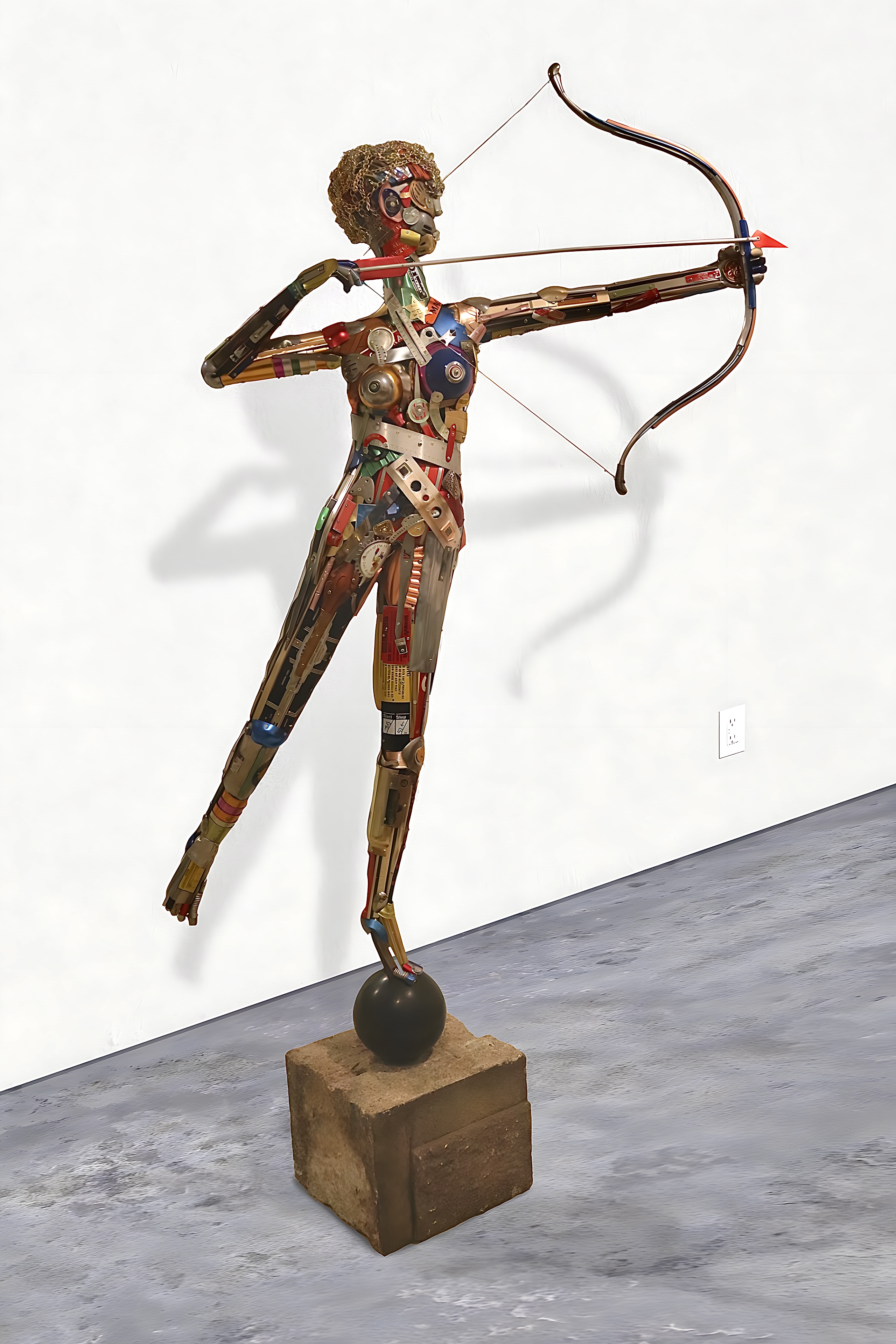
A found-object commission is a one-of-a-kind sculpture assembled from thousands of small manufactured objects — metal, wood, and plastic — fastened into a single coherent form. Unlike a cast edition, no two exist. Leo Sewell has spent more than fifty years on this practice and has produced over 4,000 works, so a commission draws on a deep, tested body of experience rather than a one-off experiment.
Because the medium is literally built from objects, a commission can carry meaning that other media can't: the things woven into the surface can be yours. That is the quiet superpower of the form — the material can be autobiographical.
How does the commission process work?
The studio keeps the process simple and transparent, in four stages (the full version lives on the commissions page):
- Consultation. You describe the subject, the setting it will live in, rough dimensions, and any objects you'd like included.
- Concept and estimate. Leo proposes an approach and a price for your approval before any building begins.
- Creation. The piece is assembled by hand, object by object, with updates at meaningful milestones.
- Delivery. Smaller works ship; larger works are coordinated for installation.
How much does a commissioned sculpture cost?
Price scales with size, complexity, and time. As a rough frame, small tabletop pieces sit at the lower end and life-size figures or public installations at the higher end — but every commission is quoted individually after the consultation. (This is a general guide, not a fixed price list.)
What you're paying for is genuine, museum-grade provenance. Leo Sewell's work is held in over forty museums and in private collections worldwide, and corporate clients including NBC and Nike have commissioned or collected his sculpture. A commission places your piece in that lineage.
What makes a good subject for a commission?
Almost anything, but a few directions consistently work well:
- Animals. Naturalistic subjects and animals feature prominently in Leo's work, from ducks and penguins to a life-size Great Dane — they translate beautifully into assembled objects.
- Portraits and figures. A person, a mascot, or a symbolic figure.
- Objects with a story. Commissions built around a family's own belongings — a late parent's tools, a collection of keepsakes — turn sentiment into a permanent object.
- Public and corporate pieces. Scale is not a barrier; Leo has built work as large as a forty-foot Statue of Liberty hand and torch.
Browse the recent work to see the range of subjects and finishes, then bring the one that speaks to you to the studio.
How do you prepare for a consultation?
You don't need to arrive with a finished brief, but a little preparation makes the concept stage faster and the estimate sharper. Before you reach out, it helps to have a rough sense of:
- The subject. An animal, a person, a mascot, an object — even a loose idea is enough to start.
- The setting. Where will it live? A mantel, a lobby, a garden, a boardroom? Scale and durability follow from the answer.
- A size range. Tabletop, life-size, or monumental. You don't need exact dimensions, just a ballpark.
- Any objects you want included. This is the part unique to found-object work. If you have meaningful items — a parent's tools, a team's memorabilia, a collection that's been in a drawer for years — gather them and note what they are. They can become the literal material of the piece.
- A timeframe. If the sculpture is a gift or tied to an event, say so early so the schedule can be planned honestly.
None of this is binding. It simply gives Leo enough to propose a direction and a fair price, and it means the first conversation moves you forward instead of in circles.
Ready to start?
If you have a subject — or a box of objects that deserve another life — the commissions page is the place to begin. Tell the studio what you're imagining, and Leo will take it from there.