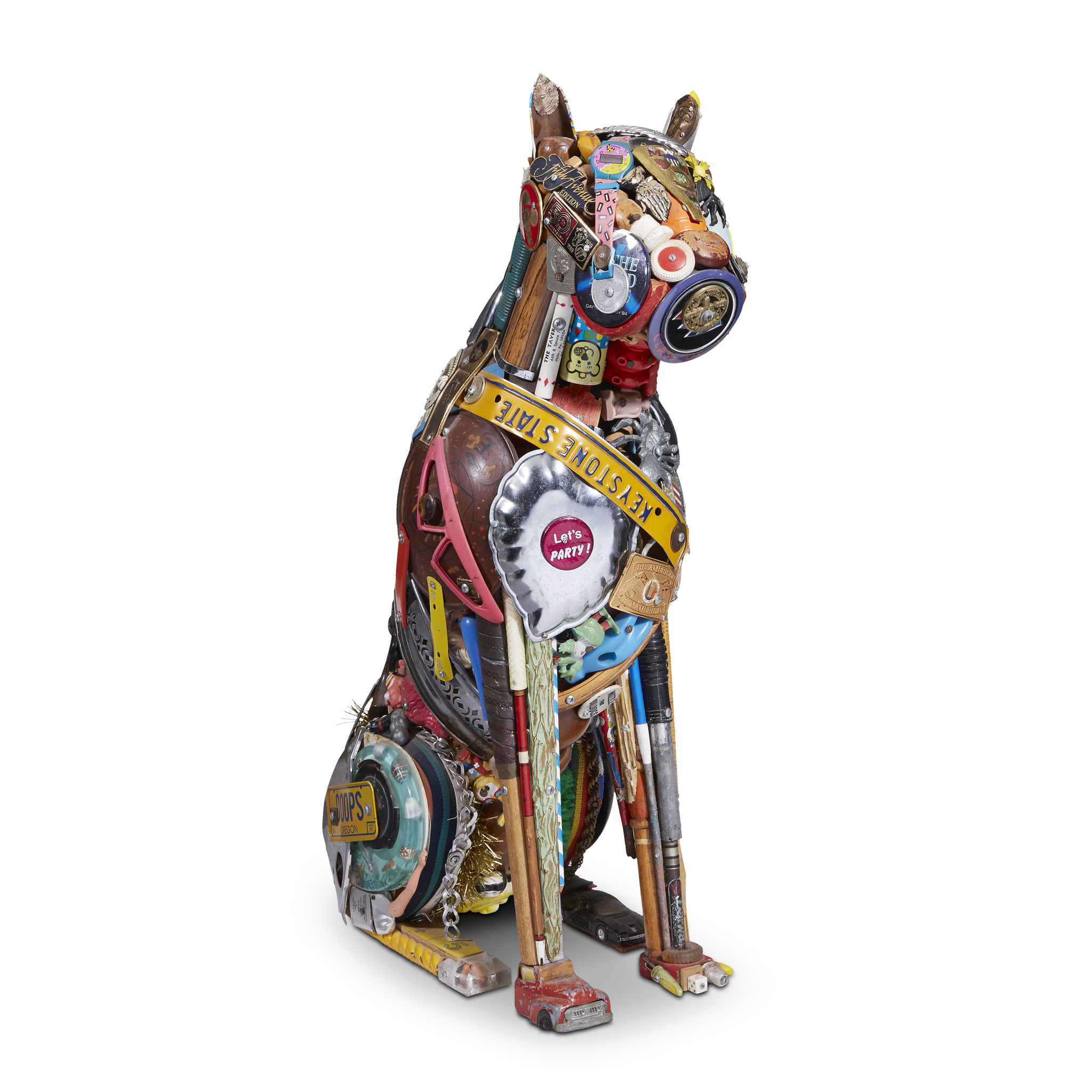
Leo Sewell: Philadelphia's Found-Object Sculptor
Leo Sewell is one of Philadelphia's best-known found-object sculptors. He moved to the city in 1974 and has worked there ever since, building thousands of assembled sculptures from salvaged metal, wood, and plastic. If you're looking for a Philadelphia sculptor for a commission, a collection, or simply to understand the city's recycled-art tradition, his half-century here is the through-line — and the commissions page is where a local project can begin.
TL;DR
- Leo Sewell has been a working Philadelphia sculptor since 1974.
- He co-founded the Philadelphia Dumpster Divers, the city's reclaimed-art collective.
- His public and institutional work includes a forty-foot Statue of Liberty hand and torch.
- His sculpture is held in 40+ museums worldwide, but the practice is rooted in Philadelphia.
- Commission a local piece via the commissions page, or see the recent work.
Is Leo Sewell a Philadelphia artist?
Thoroughly. Sewell moved to Philadelphia in 1974 and has made it his home base for the entire mature arc of his career. That's not incidental biography — the city's flea markets, stoops, yard sales, and cast-offs are the raw supply chain for the work. A found-object practice is only as good as its scavenging grounds, and Philadelphia has been his for fifty years.
By 1982, while working in Philadelphia, his sculpture had already reached a national audience through television — an early sign that a very local practice was resonating well beyond the city.
How is Leo part of Philadelphia's art culture?
Beyond his own studio, Sewell helped build the scene around him. He is a co-founder of the Philadelphia Dumpster Divers, the city's artists' group devoted to making art from reclaimed material. That matters for context: Philadelphia has a genuine, organized culture of turning waste into art, and Sewell is one of its anchors rather than a lone eccentric. For a city with a deep maker tradition, found-object sculpture is a natural civic fit.
How did a Philadelphia sculptor build a wider reputation?
Sewell's base has always been Philadelphia, but his audience never stayed local. As early as 1982, while working in Philadelphia, his work had reached national television. In 1997 he showed in "Hello Again!", a recycled-art-focused show which opened at the Oakland Museum and travelled across North America — placing a Philadelphia studio practice inside a national conversation about art made from waste. Today his sculpture is held in over forty museums and private collections worldwide.
The pattern is consistent, and it's a useful one for any regional artist: deep local roots, national and international reach. The city supplies the raw material and the community; the work travels on its own merits.
What makes Philadelphia a natural home for found-object art?
Philadelphia is a maker's city — a place of workshops, row-house tinkerers, flea markets, and a long habit of reuse. Found-object sculpture fits that character almost perfectly. It's an art form built from the discarded stuff of daily urban life, made by hand, valuing ingenuity over expense. An organized collective like the Dumpster Divers doesn't emerge just anywhere; it emerges in a city already fluent in salvage and self-reliance.
For Sewell, that environment is both studio and subject. The objects in the work are, in a real sense, pieces of the city and its cast-offs — which makes a Philadelphia commission feel less like buying a sculpture and more like keeping a piece of the place.
Where can you see his work around Philadelphia and beyond?
Sewell's reach runs from the intimate to the monumental. On the large end, his public and institutional work includes a forty-foot Statue of Liberty hand and torch — the kind of civic-scale piece that plants found-object art firmly in public life. On the collectible end, his sculpture is held in over forty museums and private collections worldwide.
That breadth means the work turns up in a lot of places — children's museums, public institutions, corporate lobbies, and private homes — often where you least expect it. The best strategy for seeing it in person is twofold: watch for regional exhibitions and public installations, and view available pieces directly through the studio. Because the sculptures reward close looking in a way photographs can't capture, seeing even one in the flesh is worth the effort — it's the difference between reading about the double-take and actually experiencing it.
If you'd like to see work without waiting for a show, the recent work page is the most direct route, and the studio can point serious buyers and visitors toward pieces currently on view.
Can you commission a piece locally?
Yes — and being local has advantages. For clients in and around Philadelphia, larger installations can be coordinated and installed in person, while pieces for collectors farther afield are shipped. The subject is up to you: animals, figures, portraits, or a work built around objects with personal meaning.
If you're in the region and have an idea — or a piece of the city you'd like made permanent — start on the commissions page, or browse the recent work to see the range first.