What Is Found-Object Art? From Dada to the Dumpster
Found-object art is art made from everyday manufactured things — objects that were made for some other purpose, then chosen by an artist and presented, or reassembled, as art. Instead of carving marble or applying paint, the artist's key decision is selection: recognizing that a discarded thing can carry meaning once it's moved into the context of art. Leo Sewell's sculpture is a contemporary, maximalist form of this idea — not one object, but thousands, fastened into a single figure.
TL;DR
- Found-object art turns existing manufactured objects into art through selection and arrangement.
- Its modern lineage runs through Marcel Duchamp's "readymades" and was used extensively by Dada, Surrealist, and Pop artists.
- "Assemblage" is the three-dimensional, many-object branch of the idea — where Leo Sewell works.
- Sewell studied this history directly, writing a master's thesis on the found object in Dada and Surrealism, and has since made 4,000+ works.
- See the tradition in practice in the recent work, or read more about the artist.
Where did found-object art come from?
The modern story starts with one radical gesture. The term readymade was first used by French artist Marcel Duchamp to describe the works of art he made from manufactured objects — most famously an ordinary object presented, essentially unaltered, as sculpture. The provocation was simple and permanent: if the artist chooses it and declares it art, does craft even matter? A century later, we're still living inside the questions Duchamp opened.
From there the idea spread fast. Extensive use of found objects was made by Dada, Surrealist, and Pop artists, each generation bending it to different ends — Dada toward irreverence and chance, Surrealism toward the uncanny, Pop toward the imagery of mass consumption. What began as a one-object shock became a whole vocabulary for making art out of the manufactured world.
Readymade, assemblage, found object — what's the difference?
These terms overlap, so it's worth untangling them:
- Readymade — a single manufactured object presented as art, more or less unaltered. Duchamp's coinage.
- Found object — the broader category: any existing, non-art object an artist incorporates into a work.
- Assemblage — the three-dimensional practice of combining many found objects into a sculpture. Think collage, but built in space.
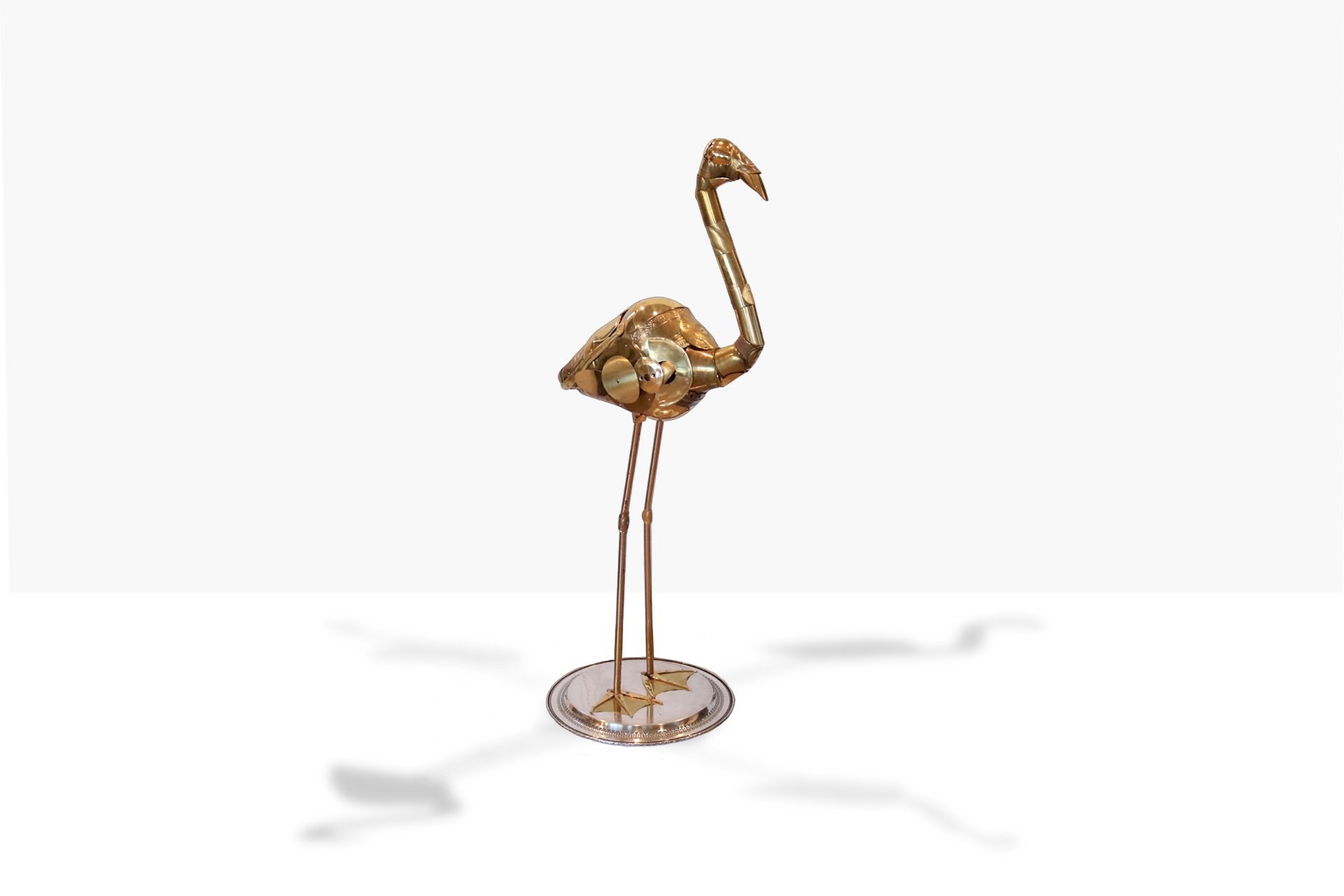
Leo Sewell's work sits squarely in the assemblage tradition, and pushes it to an extreme. Where a readymade asks you to reconsider one object, a Sewell sculpture asks you to reconcile hundreds at once — each still recognizable, all conscripted into the shape of a bear, a flamingo, or a figure.
It's worth adding one more distinction, because people often mix them up: collage and assemblage are cousins. Collage is flat — paper and images arranged on a surface. Assemblage is collage stood up into three dimensions, made of objects rather than pictures. Sewell's sculpture is assemblage in its fullest sense: not a relief hung on a wall, but a free-standing form you can walk around, built entirely from things that used to be something else.
How does Leo Sewell fit into this tradition?
Unusually directly. Long before the sculptures, there was the scholarship: Sewell wrote a master's thesis on the use of the found object in Dada and Surrealism. So the practice isn't a stylistic accident — it's an artist who studied why the found object matters in modern art, then spent fifty years answering the question in three dimensions.
His contribution is one of density and subject. Historic readymades tend toward the singular and the deadpan; Sewell's assemblages are exuberant and naturalistic, thousands of objects resolved into living forms. And he has done it at volume — more than 4,000 works over fifty years — which turns a conceptual lineage into a sustained, recognizable body of work.
There's also a communal dimension. Sewell is a co-founder of the Philadelphia Dumpster Divers, an artists' group built around making art from reclaimed material — a reminder that the found-object impulse isn't just an art-historical footnote but a living, local culture.
How do you actually look at a found-object sculpture?
Found-object work asks for a specific kind of attention, and it repays it. A simple way to look:
- Start far away. Let the silhouette register first. From a distance the piece reads as its subject — an animal, a figure — and nothing else.
- Walk in slowly. Somewhere on the approach the surface breaks apart into individual objects. That moment of dissolution is the artwork's central effect; don't rush past it.
- Read the parts. Now hunt. Find the toy, the tool, the typewriter key, the bottle cap. Notice how a curve of chrome becomes a muscle, or a worn dial becomes an eye.
- Zoom back out. Watch the objects resolve into the subject again. The pleasure is in holding both readings at once — the thing it's made of and the thing it depicts.
This double vision is the whole game of found-object art, and it's why the work is so well suited to being seen in person. A photograph flattens it; standing in front of it, you get the switch between "pile of objects" and "living form" that a screen can't reproduce.
Assemblage, in particular, rewards this because there's simply more to find — a single readymade makes its point once, while a dense assembled sculpture keeps releasing new details the longer you look. It's art that gives back in proportion to the attention you bring.
Why does found-object art still matter?
Two reasons, one old and one newly urgent.
The old reason is perceptual. Found-object art retrains how you see. Once you've stood in front of a sculpture and watched a "duck" dissolve into typewriter keys, toy parts, and bottle caps, you start noticing the discarded world differently — the medium changes your eyes.
The newer reason is material. In an age fluent in the language of waste and recycling, art literally made from cast-offs carries an argument in its very substance. A sculpture assembled from trash doesn't have to say anything about consumption; it is the statement. That's part of why this work reads as contemporary even though its roots are a century deep.
That relevance isn't only a studio idea — it has museum weight. Recycled and found-object art has been the subject of major touring exhibitions; Leo Sewell, for instance, showed in the 1997 exhibition "Hello Again!", a recycled-art-focused show which opened at the Oakland Museum and travelled across North America. When institutions build shows around art made from waste, they're recognizing a lineage that runs from Duchamp's provocation straight through to the environmental questions of the present. Found-object art, in other words, keeps finding new reasons to matter — first as a challenge to what art is, and now as a mirror for what a throwaway culture does.
For Leo Sewell, those two threads meet in every piece: a century of art history about the found object, and a very present-tense argument about the things we discard — resolved, object by object, into something worth keeping.
See it for yourself
The fastest way to understand found-object art is to look closely at a piece until it comes apart into its objects and then reassembles into a subject. Spend some time with the recent work, where the effect is on full display, or read more about Leo Sewell and the fifty-year practice behind it.